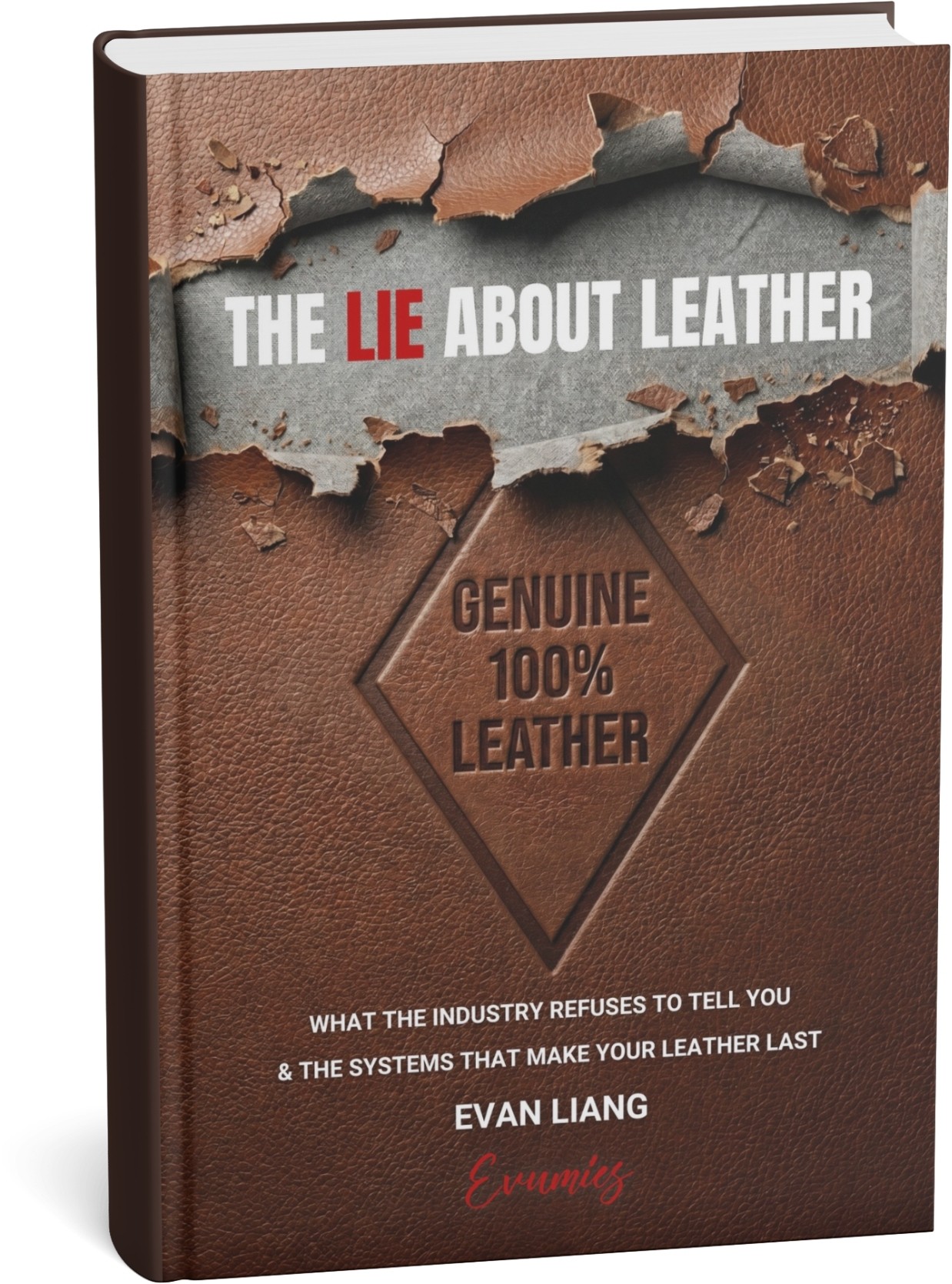
It's not real leather and it's about to fall apart and add to the landfill. The industry has been misleading you for years — and this guide will show you exactly what you own, and the system that makes genuine leather last a lifetime.
JOIN THE WAITLIST
The truth the industry hides.
That $150 designer bag.
The $120 sneakers.
The $1,500 couch.
It's not real leather and it's about to fall apart and add to the landfill. The industry has been misleading you for years — and this guide will show you exactly what you own, and the system that makes genuine leather last a lifetime.
The Truth Nobody Told You
Your expensive leather is dying right now. And the retail industry is banking on it.
You didn't overpay. You didn't buy something cheap. You bought something real — a $300 bag, $150 boots, a jacket you saved for — and nobody handed you the instructions. That's not an accident. It's a business model.
They profit when you replace
Confusing labels. Misleading quality grades. Expensive services for problems you could solve yourself in ten minutes. They profit when you replace things. They profit when you pay someone else to do what takes anyone five minutes to learn.
They profit most from your self-doubt
Nobody sat you down and explained the difference between finished and unfinished leather. No one told you that most all-purpose leather sprays are closer to furniture polish than actual care. You were handed a product without the instruction manual, then made to feel guilty for not instinctively knowing how to use it.
A customer who knows is a customer who doesn't replace
The instruction manual was never missing by accident. A customer who knows how to extend the life of what they bought is a customer who doesn't need to replace it — and that's a liability on a volume-based balance sheet. Schools don't teach material stewardship. Most brands don't either.
"Every leather item you throw away early is a small vote for a system designed to profit from your confusion. Stewardship is how you opt out."
— Evan Liang, The Lie About Leather
Here's the shift
Understanding your leather isn't just practical — it's a reclamation of power. When you know what type of leather you own, what it needs, and what it can't tolerate, you stop being a passive consumer and become a steward.
→
You make fewer panicked purchases
→
You waste less
→
You extend the life of something designed, at its core, to outlast you — if treated well
→
You opt out of a system that profits from your confusion
The knowledge to fix this already exists. This book organizes it, tests it, and hands it back to you in a form you can actually use.
The 3-C's System is the exact, non-negotiable sequence that delivers results across every leather type, item, and situation — boots, bags, furniture, car seats, jackets, wallets. The system works on the $4,000 heirloom bag and the $60 everyday sneaker. Most leather that ends up in the trash isn't ruined. It's just thirsty.
C1
Step One
Clean
Remove what doesn't belong. Cleaning means transferring contaminants off the leather using the least aggressive method that works. If you condition before you clean, you're not moisturizing — you're pressing dirt, salt, and sweat deeper into the grain, where they silently grind away at the fibers from the inside.
pH-balancedMechanical firstNever dish soap
C
C2
Step Two
Condition
Replenish what the leather needs. Every day you use leather, you pull oils out of it through flexing, heat, and evaporation. Those oils are what allow the collagen fibers to slide past one another instead of snapping. Conditioning isn't about making leather shiny — it's about keeping the fiber structure alive.
Oil-basedAfter cleaning onlyLess, more often
C
C3
Step Three
Conserve
Protect the ground you just gained. Conservation lives in small, boring decisions — shoe trees, dust bags, a 15-second brush before putting shoes away. A tiny act at the end of the day can prevent hours of restoration later. That's not discipline. That's leverage. The highest form of stewardship.
Cedar treesProper storageDaily brushing
C
2+Generations a well-kept leather jacket can survive
5 yrsHow fast a neglected one ends up in a landfill
10 minAll the time the full 3-C's routine takes
The Framework
Three steps. In that order. Every time.
The 3-C's System is the exact, non-negotiable sequence that delivers results across every leather type, item, and situation — boots, bags, furniture, car seats, jackets, wallets. The system works on the $4,000 heirloom bag and the $60 everyday sneaker. Most leather that ends up in the trash isn't ruined. It's just thirsty.
C1
Step One
Clean
Remove what doesn't belong. Cleaning means transferring contaminants off the leather using the least aggressive method that works. If you condition before you clean, you're not moisturizing — you're pressing dirt, salt, and sweat deeper into the grain, where they silently grind away at the fibers from the inside.
pH-balancedMechanical firstNever dish soap
C
C2
Step Two
Condition
Replenish what the leather needs. Every day you use leather, you pull oils out of it through flexing, heat, and evaporation. Those oils are what allow the collagen fibers to slide past one another instead of snapping. Conditioning isn't about making leather shiny — it's about keeping the fiber structure alive.
Oil-basedAfter cleaning onlyLess, more often
C
C3
Step Three
Conserve
Protect the ground you just gained. Conservation lives in small, boring decisions — shoe trees, dust bags, a 15-second brush before putting shoes away. A tiny act at the end of the day can prevent hours of restoration later. That's not discipline. That's leverage. The highest form of stewardship.
Cedar treesProper storageDaily brushing
C
2+Generations a well-kept leather jacket can survive
5 yrsHow fast a neglected one ends up in a landfill
10 minAll the time the full 3-C's routine takes
TRUSTED COLLABORATORS
The Only Math That Matters
Stop asking “What does this cost?” Start asking “What will this cost me per use?”
A cheap belt that dies every season costs more than a full‑grain belt that lasts fifteen years. The difference isn’t the leather. It’s the care — and whether anyone ever taught you how to give it.
Scenario A
Fast‑fashion belt
Looks good for one season, then fails.
Scenario B
Full‑grain belt + care
Built and maintained for the long game.
Upfront spend
$30 × 1 season
$120 once
Real lifespan
~4 months, then cracks
15+ years with basic care
10‑year spend
$30 × 10 = $300
$120 + a few dollars of care
Price per wear*
$300 ÷ ~400 wears ≈ $0.75
$120 ÷ ~1500 wears ≈ $0.08
*Illustrative numbers. The point is simple: quality plus care beats cheap plus replace every single time.
The most expensive leather you’ll ever own isn’t the piece you splurged on. It’s the one you threw away early because nobody showed you how to keep it.
This book pays for itself the first time you save a pair of boots.
Every extra year you get from leather you already own is money you never have to spend again. The 3‑C’s System is how you unlock that.
Our grandparents didn’t replace things. They maintained them.
That mindset didn’t disappear because we got smarter. It disappeared because someone figured out it was less profitable than replacement. Every leather item you throw away early is a tiny vote for that system. This book is about learning how to vote differently.
What you were never taught
Schools don’t teach material stewardship. Most brands don’t either. Nobody explained why salt lines destroy boots, why dust quietly pulls life out of leather, or why a two–minute brush-down matters more than another impulse purchase. You weren’t careless. You were under‑informed on purpose.
Stewardship in real life
Stewardship isn’t perfection or a 20–step ritual. It’s the quiet habit of doing the small things before damage shows up: wiping salt before it sets, conditioning before leather stiffens, storing pieces so they can breathe instead of suffocate.
•Brushing boots before the dirt becomes sandpaper.
•Conditioning a favorite bag once a season instead of replacing it every two years.
•Storing jackets on real hangers so the shoulders you paid for don’t collapse.
“Stewardship is the moment you stop asking ‘How long will this last?’ and start asking ‘How long am I willing to care for it?’”
This book shows you how to answer that question in ten minutes at a time.
You don’t need a workshop, a cobbler’s bench, or a wall of products. You need a simple, repeatable practice you’ll actually do.
That’s what the 3‑C’s System turns stewardship into.
Why This Book Matters
This isn’t a coffee‑table book. It’s an instruction manual for everything you already own.
The right knowledge turns “I hope this lasts” into “I know exactly how to keep this alive.” The Lie About Leather is written so that a tired pair of boots, a designer bag, or a leather couch stops feeling fragile — and starts feeling like something you know how to handle.
01 — Immediate wins
Quick‑find guides, emergency fixes, and 10‑minute routines mean you can grab a chapter, save a piece of leather today, and see the payoff before you ever finish the book.
02 — Long‑term savings
Extending the life of a single bag, jacket, or pair of boots by a few years easily outweighs the cost of the book. After that, every item you rescue is profit.
03 — Less guilt, more confidence
No more staring at a stain, afraid to touch it. No more quietly feeling wasteful when you toss something that “maybe” could have been saved. You’ll know what to do, or when it’s truly done.
04 — A quieter kind of sustainability
You don’t have to change your whole life to make a difference. Caring for what you already own is one of the most practical, honest environmental choices you can make.
If you own even one piece of leather you care about, this book is the difference between hoping it survives and knowing it will.
If you’ve ever looked at a piece of leather and thought, “I hope I don’t ruin this,” this book is for you.
This isn’t written for cobblers or collectors. It’s written for the everyday owner who wants their boots, bags, jackets, and furniture to actually live up to the price tag.
This book is for you if…
•
You own at least one leather item you’d be upset to lose — boots, a bag, a jacket, a sofa, a car interior.
•
You’ve Googled a leather question before and gotten fifteen conflicting answers from strangers.
•
You’d rather invest ten minutes in care than hundreds of dollars replacing something that “should have lasted.”
•
You care about sustainability, but you don’t want a lecture — you want practical steps.
This book is probably not for you if…
•
You see leather as disposable and plan to replace pieces every year no matter what.
•
You want a chemistry textbook, not a practical handbook written in plain language.
•
You’re looking for a magic product that fixes everything without changing any habits.
If you see yourself in the “for you” column, this book will change how you look at every leather item you touch from now on.
It's not real leather and it's about to fall apart and add to the landfill. The industry has been misleading you for years — and this guide will show you exactly what you own, and the system that makes genuine leather last a lifetime.
JOIN THE WAITLIST
The truth the industry hides.
That $150 designer bag.
The $120 sneakers.
The $1,500 couch.
It's not real leather and it's about to fall apart and add to the landfill. The industry has been misleading you for years — and this guide will show you exactly what you own, and the system that makes genuine leather last a lifetime.
Still On The Fence?
If you’re even thinking about this page, you already own something worth keeping.
“What if I’m brand new to leather?”
Perfect. This book was written for people who don’t know the jargon. You’ll learn exactly what you’re holding, what it needs, and what to avoid — without needing a chemistry degree.
“I don’t have time for a 300‑page project.”
You don’t have to read it straight through. Quick‑find guides, 10‑minute routines, and emergency sections let you grab exactly what you need, right when you need it.
“Will this actually pay off?”
Extending the life of a single pair of boots, a bag, or a jacket by a few years easily beats the price of the book. After that, every item you rescue is money you keep.
“Can’t I just keep googling?”
You can — but conflicting advice is how good leather dies. This handbook organizes the best of that information, pressure‑tests it, and hands it back in one place, written to actually be used.
One book. Three steps. A lifetime’s worth of leather you don’t have to feel nervous about touching.
Your future self — and your future boots — will thank you.