How To Remove Creases At Home
April 2025
The Hidden Cost of Neglect
Believe it or not, most people ruin their leather footwear at home. Not on the pavement, not at the job site — at home, the moment they kick them off and leave them on the floor.
The damage is invisible for a while. Then one day your toe box is cracked, the heel counter has collapsed, and the creases look like scars instead of character. By that point, the cobbler bill is real. The regret is real. And neither was necessary.
Nobody handed you the system. That's the only reason this keeps happening.
The Damage That Happens Twice
Every time you wear your boots, two moments decide their fate: how you put them on and how you treat them the second they come off. Most people lose on both counts.
Forcing your foot into a boot without a shoehorn crushes the heel counter — that stiff structural piece that holds the shape of the boot. Once that collapses, it never fully recovers. The fibers start breaking down and the boot starts aging wrong. Not gracefully. Just old.
Then, leaving your boots empty and damp after wear is how the inside of your leather quietly rots. Leather is organic. It absorbs every drop of sweat from your foot, and if nothing is there to pull that moisture out and hold the boot's shape while it dries, the leather contracts incorrectly. Deep vamp creases. Premature cracking at the toe box. A boot that looks like it's been through a decade of abuse after eighteen months of regular wear.
The fix for both of these is simple, affordable, and takes less than five minutes.
The Five Tools That Change Everything
These five tools cost less than a single shoe repair at a cobbler. Used in the right order, every time, they are the entire system.
Tool 1: A Shoehorn
Use it every single time you put your boots on. Insert the horn at the heel, slide your foot in, pull it out. One second. The horn protects the heel counter, the counter protects the shape, and the shape determines the long-term value of the boot in your eyes. Any horn beats no horn — metal, plastic, whatever you have. If you want something worth keeping on your shelf, the real horn shoehorn from Grant Stone is worth it. There's also an affordable metal option on Amazon for anyone just getting started.
Tool 2: Cedar Shoe Trees
Insert them immediately after every wear. Not the next day. Not after the boots dry. The moment the boots come off. Cedar does two things simultaneously — it absorbs moisture and odor-causing bacteria, and it holds the boot in its anatomical shape so the leather dries correctly. If you own one good pair of boots and nothing else on this list, get the cedar shoe trees. Grant Stone's cedar boot trees are built to fit their lasts specifically. Amazon also has solid cedar boot trees and cedar shoe trees if you need a more universal fit.
Tool 3: A Horsehair Brush
Ten seconds after every wear. Dust and ambient grime act as a microscopic desiccant — they pull moisture out of your leather and dull the surface. A horsehair brush removes that layer before it can do damage. Brush with the grain, light to medium pressure, and you'll see the luster come back almost immediately. The Grant Stone horsehair brush is what I've been reaching for lately. There's also a solid option on Amazon. Skip the synthetic brushes — horsehair bristles are porous in a way that plastic never will be. You can't condition over grime, and you can't restore what you can't access. The daily brush is what makes every other step work.
Tool 4: A Deer Bone
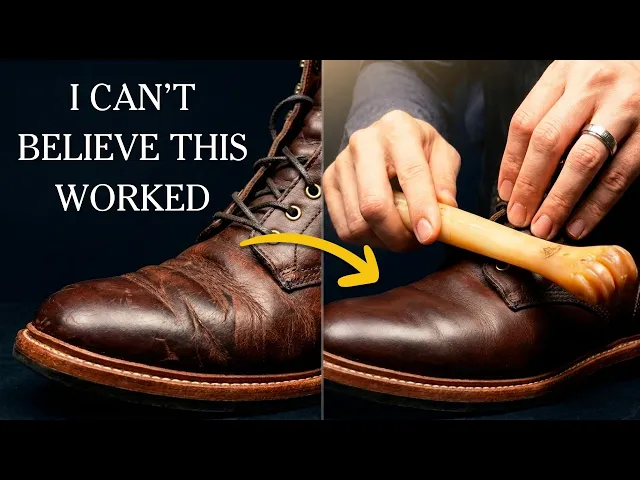
This is the one most people have never heard of. Cobblers and soldiers have used deer bone tools for centuries — not because it's a trend, but because it works in a way no product can replicate. Daily wear creates micro compressions in the leather fibers, small creases that accumulate in the toe box and flex areas. Most people reach for more conditioner. The real fix is mechanical. The bone is naturally oil-embedded. That smooth, oil-saturated surface glides across the leather without marking it, while the friction and pressure physically realign the compressed fibers underneath. It's not removing material. It's restoring what was already there.
Before you pick up the bone, apply a thin layer of conditioner or cream to keep the surface slick. Keep the shoe tree in place — it gives you the firm surface you need to apply real pressure without deforming the boot. Use only the smooth side. Work in firm, deliberate strokes over the toe box and any flex crease areas. It's rhythmic. Honestly, it's cathartic. Depending on the depth of the creases, it can take anywhere from ten minutes to a full hour per shoe. That's not a downside. That's the beautiful thing about real leather. You can spend an hour honoring it and bring it back. Try doing that with bonded leather that's already peeling before you even reach for the bone. The deer bone tool is available through Grant Stone.
Tool 5: Conditioner
Here's something nobody tells you when you unbox a new pair of boots: the leather may not have been properly hydrated in six months to a year. Between leaving the tannery, moving through the supply chain, sitting in a warehouse, and finally arriving at your door — those fibers have been sitting without nourishment. It looks rich. It looks new. But on a fiber level, it's already thirsty before you've taken a single step. I call it the supply chain drought.
This is why I condition every pair of boots on day one. Not because it looks like it needs it. Because I know that it does. It also gives me a clean starting point — I know exactly when I last conditioned, no guessing. The clock starts the day it comes home. Saphir Renovateur is what I use and trust — it's also available on Amazon. If your leather is dry or cracked, reach for this oil leather conditioner first. And if you're working with suede, this is my go-to suede cleaner.
Why Quality Leather Responds Better
If you're buying from a brand that sources from tanneries like Horween in Chicago, you're starting with a real advantage. Horween is known for a process called fat liquoring — working oils and fats deep into the leather fiber structure during tanning itself. That builds in suppleness and longevity from day one. The leather has a stronger baseline and responds better to conditioning over time. Buying quality isn't just about aesthetics. It's about buying leather that wants to be cared for.
Even the best leather in the world doesn't take care of itself. That's where you come in.
The System, In Order
Every time. No shortcuts.
Shoehorn at entry — protect the heel counter before your foot goes in
Cedar shoe trees immediately after — absorb moisture, hold shape, dry correctly
Horsehair brush daily — remove grime before it pulls moisture out
Deer bone as needed — mechanically restore compressed fibers at the toe box
Conditioner as needed — nourish the fiber, starting on day one
Do this consistently and your boots will look better in five years than they do the day you bought them. That's not a claim — it's just what happens when you care for something properly.
All tools mentioned are linked above. If you already have some of these at home, use what you have. You don't need to buy new ones to start doing this right.
Watch the Full Video
See every step of this process in the video this post is based on.
Evumies Recommends
Products We’ve Tested & Trust
EVUMIES RECOMMENDED
Leather Honey Leather Conditioner
Keeps leather supple and crack-free — one coat lasts up to 6 months.
4.9
See on Amazon
EVUMIES RECOMMENDED
Bickmore Bick 4 Leather Care
Restores moisture to dried leather without darkening or leaving any residue.
4.7
See on Amazon
As an Amazon Associate, Evumies earns from qualifying purchases.